The short answer
A grey, deep-corrugated fibro roof on a house built before 1990 may well be asbestos cement; the Queensland Government says such houses have “a good chance” of containing asbestos, and only a laboratory test confirms it. A sound asbestos roof can be left alone, or treated with fungicide and sealed with paint, but it must never be water-blasted: homeowners can be fined up to $10,000. Removing more than 10 m² needs a licensed removalist (or, for a homeowner, a certificate), so a whole roof is a licensed removal followed by a new roof.
How to tell if your roof is asbestos
Start with the age of the house. The Queensland Government says: “If your house was built before 1990, there is a good chance that it contains asbestos.” It adds that “Asbestos cement sheeting was commonly used in building materials from 1940s to the late 1980s”, and that outside the house it was “commonly used for roof sheeting and capping, guttering, gables, eaves/soffits”.
What an asbestos cement roof looks like
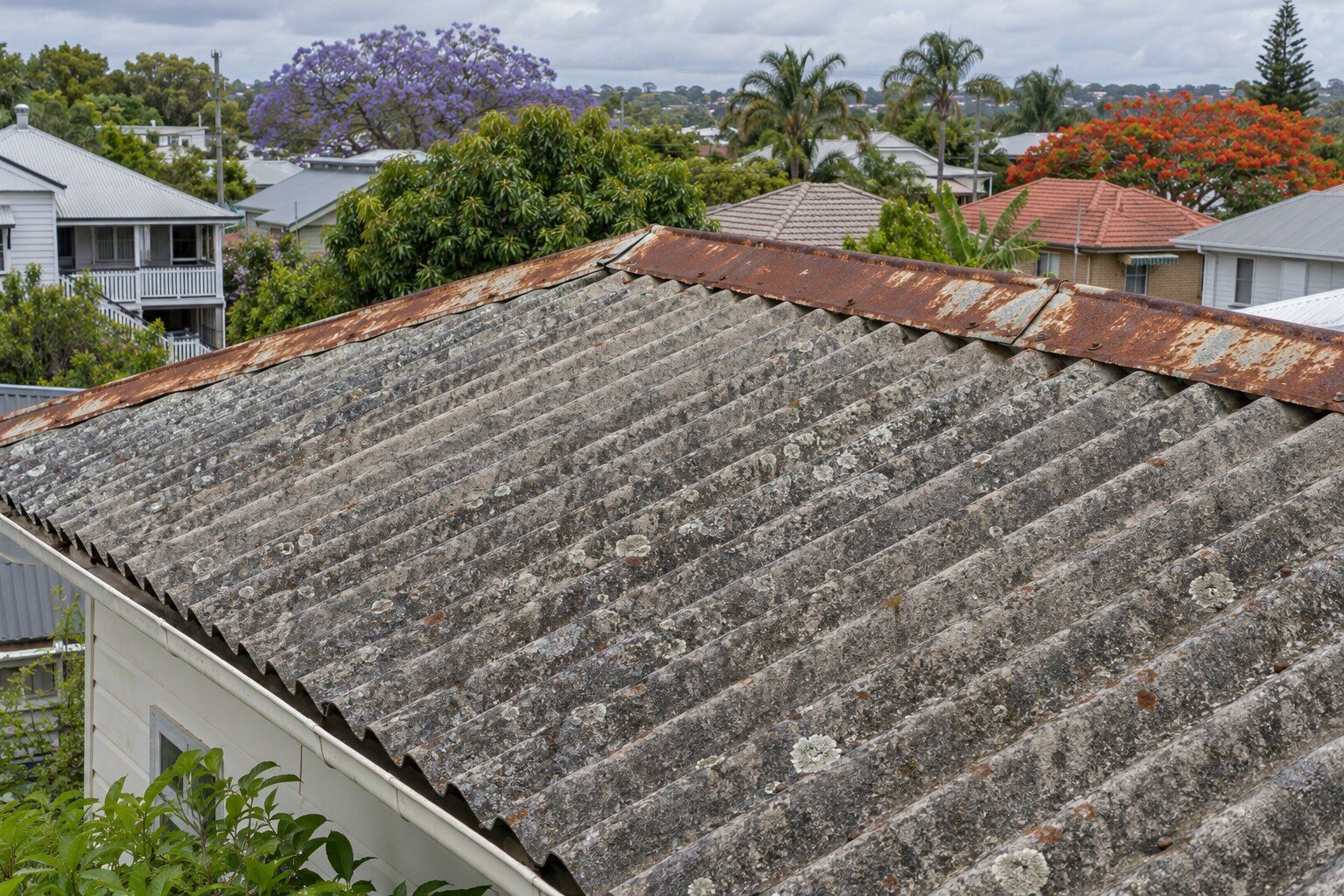
Profiled roof sheets such as Super Six are the classic asbestos roof: grey cement sheets with wide, deep corrugations, much chunkier than corrugated iron, often with fibro ridge capping and fibro gutters or eaves. The Queensland Government notes that “Over time, lichen growing on the roof sheets commonly discolours them from the original light grey into a dark grey/grey black.”
Where else to look
Check the outbuildings and the edges of the house too. The Queensland Government says that “Aside from homes, these products where also used for fencing, car ports and sheds” (sic), and lists gables and eaves among the places asbestos cement was used.
Why looking isn’t enough
The Queensland Government says: “It is often very difficult to identify the presence of asbestos by sight.” The only way to be certain, it says, is to have a piece of the material analysed by a laboratory.
Testing asbestos roof sheets
Testing means a small piece of the sheet analysed by a laboratory. The Queensland Government’s advice is that “Sampling of anything you suspect may contain asbestos is itself hazardous and should only be done by a competent person, and analysed only in accredited laboratories.” Labs can be found through the National Association of Testing Authorities (NATA), and the Government says the laboratories can advise on how to take and send it, and “There will be fees involved.”
Until it’s tested, the Government’s rule of thumb is to “assume it does” contain asbestos. Our advice: if you’re getting quotes to replace the roof, ask the licensed removalist whether testing is included.
What you can’t do to an asbestos roof in Queensland
Queensland rules for asbestos cement roofs
| Activity | What the Queensland Government says |
|---|---|
| Water blasting the roof | “It is illegal to use a high pressure water blaster on asbestos cement roofs, fences and walls.” |
| Penalty for homeowners | “Homeowners can be fined up to $10 000 for using high pressure water blasters on asbestos-containing materials and must pay for the clean-up costs.” |
| Power tools | “Never use power tools, such as angle grinders, circular saws and electric sanders (unless enclosed or used with a device or process that prevents dust)” |
| Compressed air and blasting | “Never use compressed air or abrasive blasting” |
| Vacuum cleaners | “Never use household vacuum cleaners even if they have a HEPA filter.” |
Queensland Government, asbestos.qld.gov.au, prohibited activities page (no page date shown), checked 22 October 2026. The cleaning asbestos cement roofs fact sheet (version 2, October 2020) also says fibro roofs “must not be cleaned using a water blaster”.
Our advice: don’t walk on a fibro roof at all. Old asbestos cement sheets can crack underfoot, and people fall through them.
Asbestos roof options: leave it, seal and paint it, or replace it
Leave it and keep an eye on it
The Government’s fact sheet says well-maintained asbestos cement roofs “can be left alone until they are no longer watertight.” Check from the ground and from the roof space for cracked or broken sheets and leaks.
Treat it with fungicide, then seal and paint it
Instead of cleaning, the Government says to “apply a fungicide or sealant or consider replacing it.” Its safe work procedure for a sound roof is to “apply a fungicide, lightly wash it down (using a garden hose with no nozzle attached, at low pressure), then paint it to seal the surface”, applying primer “with a brush and paint roller, not a compressor.” The procedure also covers scaffolding, edge protection and catching runoff in the downpipes. See the roof painting page for painting quotes.
Replace it
The same procedure says: “If your asbestos roof is in poor condition, consider replacing it with a roof that requires no maintenance.” Replacing means a licensed asbestos removalist takes the sheets off and a QBCC-licensed roofer fits a new roof. Published Brisbane prices are in the asbestos roof replacement cost guide.
Asbestos roof removal: who can do it
The 10 m² line decides who can remove bonded (non-friable) asbestos such as roof sheets:
- Businesses: “A licence is required to remove any amount of friable asbestos and if you remove more than 10 square metres of non-friable asbestos.” There are two licences: “friable asbestos (class A) and non-friable asbestos (class B).”
- Homeowners, 10 m² or less: “you do not require a certificate. However, you will still need to follow safe work procedures and safety precautions to minimise asbestos fibres getting into the air.”
- Homeowners, more than 10 m²: you “must hold a certificate obtained under arrangements approved or established by Queensland Health”.
A whole house roof is far more than 10 m². Our advice: with the height, the brittle sheets and the disposal rules, leave a roof removal to a licensed removalist. Licensed removal work also involves notifying Workplace Health and Safety Queensland five days before the work starts, a removal control plan and proper disposal of the waste.
Common questions
Is it safe to live under an asbestos roof?
The Queensland Government says: “Well maintained asbestos cement roofs are not a risk to human health unless they are physically disturbed or being worked on.” The risk comes from breaking, cutting, drilling or water-blasting the sheets.
What is a Super Six roof?
Super Six is the name people use for profiled asbestos cement roof sheets. The Queensland Government describes them as “corrugated cement roofing sheets, more commonly called fibro or ‘Super Six’”, made with asbestos fibres “to give the sheets strength and resistance to chemicals and the harsh environment.”
Can I drill or screw into an asbestos roof?
For homeowners, the Queensland Government says not to use a power tool to cut or clean asbestos-containing material, but “A cordless drill operating at less than 650 rpm may be used if reasonable measures are taken to minimise the release of fibres.” Our advice: get a licensed tradesperson who knows the asbestos procedures, and don’t go on the roof yourself.
How do I check an asbestos removalist’s licence?
The Queensland Government says to “ask them for a copy of their licence, then contact Workplace Health and Safety Queensland with their licence number to verify their details.” It also recommends getting “more than one quote from licensed contractors”.
My fibro roof was broken in a storm. What now?
Our advice: keep people and pets away from broken pieces, and don’t sweep, hose or vacuum them up (the Government bans household vacuum cleaners on asbestos). For storm emergencies, Brisbane City Council says to call the SES on 132 500. The Queensland Government has safe clean-up steps for storm-damaged asbestos.
How much does it cost to replace an asbestos roof?
It depends on the roof size, height and access, and published Brisbane prices vary widely. The asbestos roof replacement cost guide lists them, each with its publisher and date.
Where this information comes from
The prices, rules and advice on this page come from these published pages, checked on 22 October 2026.
- Queensland Government: homeowners, look, check and prepare · Queensland Government, asbestos.qld.gov.au (no page date shown)
- Queensland Government: how was asbestos used? · Queensland Government, asbestos.qld.gov.au (no page date shown)
- Queensland Government: common locations of asbestos in domestic and commercial buildings · Queensland Government, asbestos.qld.gov.au (no page date shown)
- Queensland Government: testing for asbestos · Queensland Government, asbestos.qld.gov.au (no page date shown)
- Queensland Government: prohibited activities · Queensland Government, asbestos.qld.gov.au (no page date shown)
- Queensland Government: cleaning asbestos cement roofs (fact sheet) · Queensland Government, version 2, October 2020
- Queensland Government: preparing and painting corrugated asbestos cement roof and fences (safe work procedure) · Queensland Government, asbestos.qld.gov.au (no page date shown)
- Queensland Government: homeowner’s certificate to remove asbestos · Queensland Government, asbestos.qld.gov.au (no page date shown)
- Queensland Government: tips when home renovating · Queensland Government, asbestos.qld.gov.au (no page date shown)
- Queensland Government: trades and contractors · Queensland Government, asbestos.qld.gov.au (no page date shown)
- Queensland Government: removing or disturbing asbestos · Queensland Government, asbestos.qld.gov.au (no page date shown)
- Queensland Government: asbestos removal work · Queensland Government, asbestos.qld.gov.au (no page date shown)
- Queensland Government: tips when hiring a contractor · Queensland Government, asbestos.qld.gov.au (no page date shown)
- Queensland Government: cleaning up after floods and storms (asbestos) · Queensland Government, asbestos.qld.gov.au (no page date shown)
- Brisbane City Council: respond to an emergency · Brisbane City Council web page, published 31 March 2025
- National Association of Testing Authorities (NATA) · Australia’s accreditation body for testing laboratories